

What to do in Madrid in 2 days
Read More »
What to do in Madrid in 2 days Visiting Madrid in two days is a truly complicated task considering the city’s numerous attractions: incredible buildings,
Madrid Barajas Airport (MAD) is by far the busiest airport in Spain and one of the most important airports in Europe. Thanks to its more than 65 million passengers per year, Barajas ranks among the top 5 busiest airports in Europe.
Arriving at Madrid-Barajas Airport for the first time can feel overwhelming, especially after a long international flight from the United States or Canada.
Fortunately, Madrid Airport is very well connected to the city center, and travelers have several comfortable and affordable transportation options available.
Whether you are visiting Madrid for a few days, connecting to another destination, or starting a longer trip across Spain, this guide explains the easiest ways to get from Madrid Airport to the city center.
👉Have a long layover in Madrid? If you have 6-7 hours between flights, it may be enough time to explore some of the city’s highlights before heading back to the airport. Check our Madrid layover tour
Madrid-Barajas Airport is located approximately 12–15 kilometers (7–9 miles) northeast of the historic center of Madrid.
Travel times can vary depending on traffic and the exact location of your hotel or apartment.
The best way to get from Madrid Airport to the city center depends mainly on your budget, amount of luggage, arrival time, and personal travel style. Below you can find a quick comparison of the most common transportation options:
Taking a taxi is one of the easiest and most comfortable way to reach central Madrid, especially if you are arriving with luggage or after a long flight.
Madrid has an official flat airport taxi fare for destinations inside the city center (€33).
Madrid’s metro system is modern, safe, and relatively easy to use.
The airport is connected to the city via Metro Line 8. Barajas has two metro stations: one serves Terminals 1, 2, and 3, since they are located together, and another metro station serves Terminal 4.
Travelers heading to the historic center (Puerta del Sol, Plaza Mayor or Gran Vía) will need to change lines at Nuevos Ministerios station. For example, to get from Madrid Airport to Puerta del Sol by metro, you first need to take Line 8 from the airport to Nuevos Ministerios station. There, you must change to Line 10 and travel to Tribunal station, where you will change again to Line 1 towards Valdecarros and get off at Sol station.
Please note that the transfer at Nuevos Ministerios is quite long and can be a bit confusing for first-time visitors, so make sure to follow the signs carefully.
The Madrid Metro operates from 6:00 AM until 1:30 AM. Keep in mind that the last trains usually leave the final stations around 1:30 AM, so it is recommended not to enter the system too late at night if you want to complete your journey without problems.
Buying your Metro tickets at the airport is very simple and straightforward! Here is a quick step-by-step guide:
Commuter trains are operated by Renfe, Spain’s national railway company, and connects the airport with major stations in Madrid such as Chamartín, Nuevos Ministerios, Atocha, and Príncipe Pío.
The commuter rail system in Spain can be a bit confusing if you’re not used to it. That’s why we’ve put together this short step-by-step guide
Step 1: Get to the Train Station
The Cercanías station is located only at Terminal 4 (T4).
If your flight arrives at Terminal 1, 2, or 3, simply follow the signs for the free airport shuttle bus that connects all terminals. The ride to Terminal 4 takes approximately 10–15 minutes.
Once inside T4, follow the signs marked “Cercanías Renfe“. Escalators and elevators will take you down to the train station.
Step 2: Buy Your Ticket
Buying tickets for the commuter train shouldn’t be a problem, since the system is similar to many other train systems.
The ticket machines are available in English and are easy to use.
You have two options:
Option 1: Contactless payment at the turnstile
Many travelers simply tap a contactless credit card, debit card, Apple Pay, or Google Pay at the entrance and exit gates.
The system automatically calculates the correct fare for your journey. Remember to tap both when entering and leaving the station.
Option 2: Buy a paper ticket from the machine
At the station, select your destination and purchase a one-way ticket from the self-service machine. Tickets can also be purchased at the ticket counter when available.
How Much Does It Cost?
A one-way Cercanías ticket from the airport to central Madrid costs €2.60 (€5.20 round-trip ticket)
This makes the train one of the most affordable ways to reach the city.
Step 3: Board the Train
Line C1 serves Madrid Airport (only Terminal 4).
Trains run frequently throughout the day, generally every 15–30 minutes.
Electronic displays clearly show the next train and its destination.
Step 4: Choose the Best Station for Your Hotel
Depending on where you’re staying, these are the most useful stops:
Travel Time
Typical travel times from Terminal 4 are:
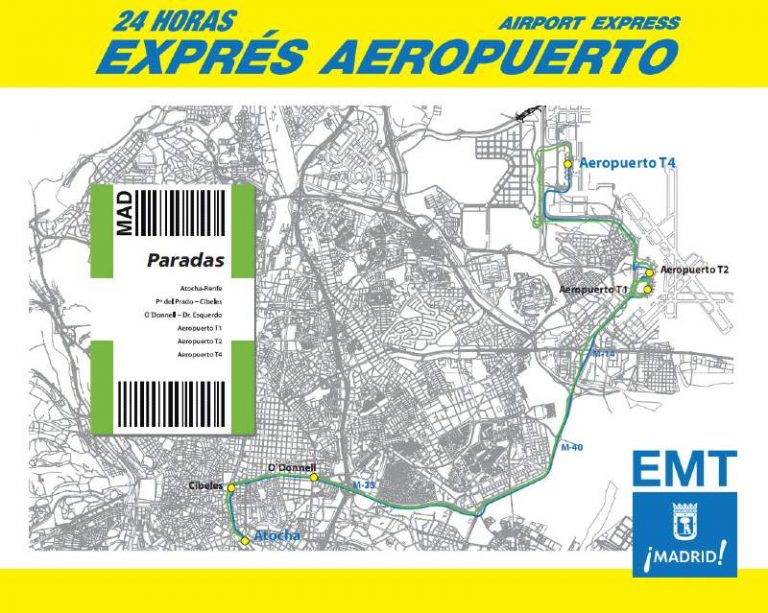
The Airport Express Bus (Exprés Aeropuerto) connects Madrid Airport with the historic center.
The bus stops are clearly indicated outside the arrivals area of each terminal, and you simply need to follow the signs for “Airport Express Bus” or “Exprés Aeropuerto.”
Airport Express Buses in Madrid are bright yellow, making them very easy to spot right outside the terminal arrivals area.
Tickets can be purchased directly on the bus, and payment by credit or debit card is accepted.
The buses are modern, comfortable, and equipped with dedicated luggage racks, making them a convenient option for travelers arriving with suitcases.
Approximate travel time:35–50 minutes depending on the traffic conditions.
The airport bus is especially useful for travelers arriving late at night, since the metro closes around 1:30 AM.
Private transfers are becoming increasingly popular among international travelers visiting Madrid.
Most travelers reserve their transfer online before arriving in Madrid.
Upon arrival, your driver typically waits in the arrivals hall holding a sign with your name and escorts you directly to the vehicle. Most services include flight tracking, meet-and-greet service, and fixed pricing with no hidden charges.
Prices vary depending on the vehicle category, number of passengers, and destination, but these are the most common ranges:
-Standard sedan (1–4 passengers) from €50
-Executive vehicle €70–€90
-Minivan (up to 8 passengers) €70–€100
If you’re looking for a private transfer from Madrid Airport, click here to see prices
Uber operates legally in Madrid, as do other similar ride-sharing apps such as Cabify and Bolt. These services are widely used by both locals and visitors and can be a comfortable alternative to traditional taxis for getting around the city.
However many visitors still prefer official taxis because the pickup process is often simpler after long international flights.
Avoid taking unlicensed taxis or those not affiliated with any of the official ride-hailing apps (Uber, Bolt, etc.).
These drivers operate completely illegally by picking up customers on foot inside the terminals. As you can imagine, their main goal is to confuse newly arrived tourists in order to charge them exorbitant fares. Furthermore, in the event of a complaint or an accident, these unlicensed taxis have no travel insurance whatsoever.
Yes. Madrid-Barajas Airport is generally considered one of the easiest large international airports in Europe to navigate, especially compared to other major hubs in Europe.
It is also important to understand that there is a major difference between the older terminals (T1, T2, and T3) and the much newer Terminal 4.
Terminals 1, 2, and 3 were originally built between the 1950s and 1970s and, although they have been renovated several times, they still reflect a more traditional airport design with narrower spaces and a less modern layout. Terminal 4, on the other hand, was inaugurated in 2006 and was specifically designed to handle the enormous growth of international traffic at Madrid Airport. In addition to these four terminals, we must include the T4S, which is an additional terminal building connected to Terminal 4. T4S is mainly used for long-haul and non-Schengen international flights, especially routes to the United States, Latin America, and Asia .
Fortunately, connections between terminals are generally straightforward. A free airport shuttle bus operates continuously between T1, T2, T3, and T4, while an automated underground train connects T4 with T4S every few minutes free of charge.
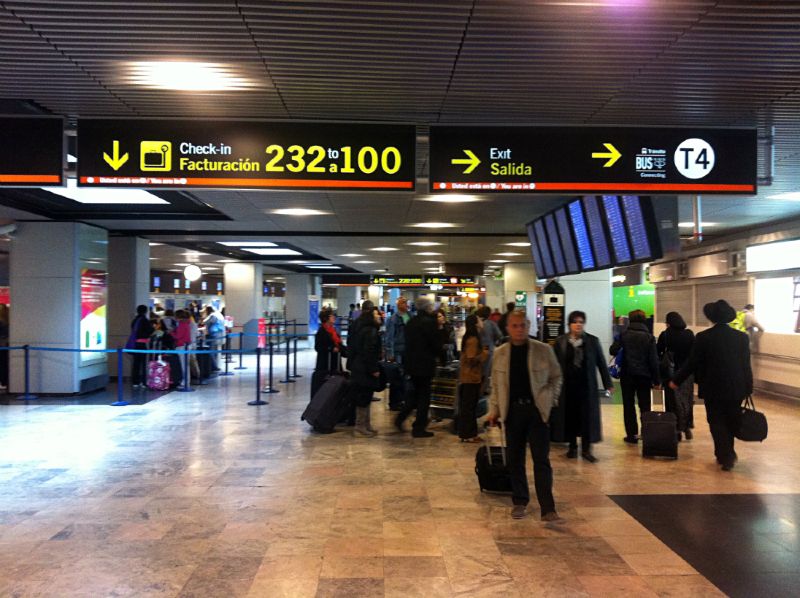
International passengers arriving from non-Schengen countries (such as the United States, Canada, or the United Kingdom) should also expect passport control queues during busy hours. It is also important to remember that Madrid Airport is one of the main international gateways between Europe and Latin America, so immigration areas can become especially busy during the morning and early afternoon arrival banks.
Instead of the traditional passport stamping process, Madrid-Barajas Airport is progressively implementing the European Union’s new Entry/Exit System (EES). This digital border control system is designed to improve security and speed up immigration procedures for non-EU travelers entering or leaving the Schengen Area.
During the process, passengers may need to scan their passport at an automated kiosk or with a border control officer. The system also records biometric information such as a facial photograph and fingerprint data.
Travelers should keep several important things in mind when arriving at Madrid Airport:
For this reason, if you have a connecting international flight at Madrid-Barajas Airport, it is highly recommended to allow at least a few hours between flights, particularly when changing terminals or traveling through T4S.
Much of the airport is occupied by Iberia and Air Europa, two major Spanish airlines connecting Madrid with Europe and South America.
The most important airlines by number of passengers operating in Madrid are (ordered from highest to lowest number of passengers)
Iberia
Air Europa
Ryanair
Iberia Express
Air Nostrum
Wizz Air
American Airlines
easyJet
Avianca
Lufthansa
In total, Madrid-Barajas handled 116 airlines and more than 500 routes during 2024-2025, being the main air hub between Europe and Latin America.
Currently, there are 6 major airlines operating direct, non-stop routes between Madrid-Barajas Airport and the United States:
Direct flights from Barajas to the U.S. cover several major regions.
Keep in mind that some of these routes are seasonal, expanding during the peak summer travel months:
East Coast
Central & Midwest Regions
West Coast
Caribbean & Southern Destinations
As guides, we love Madrid’s history and enjoy discovering how things have evolved over time to become what we see today 🙂
During the early decades of the 20th century in Spain, the first flights carrying only mail (airmail service) began operating. These flights used small runways located at military facilities.
Iberia, Spain’s flagship airline, is officially founded.
Spain makes history with its first commercial passenger flight, connecting Madrid and Barcelona. Barajas airport did not yet exist and military facilities were used
Madrid-Barajas Airport is officially inaugurated
After a two-year wait, the airport opens to civil commercial traffic and originally consisted of a small terminal building serving the few passengers who traveled by air at that time
The first year Barajas registered just 378 flights and 2,873 passengers. For comparison, Amsterdam’s main airport had 25,000 passengers that year, and London had about 35,000.
During the Spanish Civil War, commercial travel is paused, and Barajas is repurposed for military transport and logistical support.
Madrid-Barajas Airport entered a new era of growth with the opening of modern facilities designed to accommodate the rapid expansion of air travel in Spain.
Barajas was already handling more than half a million passengers a year.
Over the following decades, Spain experienced a tourism boom that transformed the country’s economy and made air travel increasingly popular. As passenger numbers continued to rise, Barajas once again required major upgrades and expansion projects to keep pace with demand.
By the late 1980s, Madrid-Barajas was serving approximately 15 million passengers annually, establishing itself as Spain’s busiest airport and one of Southern Europe’s most important aviation hubs
At the beginning of the 21st century, the airport underwent massive expansion and modernization. A new runway and an advanced air traffic control tower were added, while the landmark Terminal 4 (T4) and Satellite Terminal 4S opened to the public, providing more than 750,000 square meters (8 million square feet) of state-of-the-art facilities.
By 2015, Barajas had become the leading gateway between Europe and Latin America, welcoming 47 million passengers and strengthening Madrid’s position as a major international aviation hub.
In 2025, Madrid-Barajas reached a new milestone, setting an all-time record with 68 million passengers, making it one of the busiest airports in Europe.
The history of Madrid-Barajas has also been shaped by moments of profound tragedy. We look back at these major accidents not to dwell on the sadness, but as a respectful tribute to the lives lost.
Avianca Flight 011 (November 27, 1983) A Boeing 747 flying from Paris to Bogotá via Madrid crashed into a series of hills just miles before reaching the Barajas runway. The accident, caused by a navigational error during the final approach, resulted in the tragic loss of 181 lives.
The Runway Collision (December 7, 1983) While Spain was still recovering from the shock of the November 27th accident, 10 days later Barajas suffered another disaster on the ground. Amidst dense morning fog, an Iberia Boeing 727 taking off collided with an Aviaco DC-9 that had accidentally taxied onto the active runway. The collision and subsequent fire claimed 93 lives.
Spanair Flight 5022 (August 20, 2008) The most recent major disaster occurred when a McDonnell Douglas MD-82 bound for the Canary Islands crashed immediately after takeoff from Terminal 4. The aircraft failed to gain lift because the flaps and slats were not deployed, and the cockpit warning system failed to alert the crew. Out of 172 people on board, 154 tragically lost their lives.
It’s hard to believe, but just months after its grand opening, Terminal 4 was the site of a tragic terrorist attack. On December 30, 2006, the Basque separatist group ETA detonated a massive car bomb in the parking garage.
The blast caused a major structural collapse and shattered ongoing peace talks between the group and the Spanish government.
Tragically, two Ecuadorian citizens who were waiting in their vehicles for some relatives to arrive at Madrid airport lost their lives.
The attack backfired on ETA, sparking massive protests across Spain and accelerating the group’s eventual dissolution.
Address: Avenida de la Hispanidad s/n
Website: click here
Passenger per year: +65 million passengers
Telephone: (+34) 91 321 10 00
Metro: Barajas T1-T2 (Line 8) / T4 (Line 8 and Cercanías Renfe)
Opening Hours: 24h
Services: Restaurants, Cafeteria, VIP Area, Duty-Free, Parking, Christian Chapel, Smoking Areas, Wi-Fi, Rent a car, Tourist Information, Travel Agency, ATM´s, Exchange Offices, Luggage Wrapping Machines, Police.
What to do in Madrid in 2 days Visiting Madrid in two days is a truly complicated task considering the city’s numerous attractions: incredible buildings,
Getting Around in Madrid Getting around in Madrid couldn´t be easier. Every single day more than two million people use public transportation (metro, bus, tram,

Atocha Station in Madrid Atocha Station, located just 10 minutes away from Prado Museum, is the main railroad station in Spain. However, unfortunately, the station

Hola! My name is Javier Redondo, tour guide in Madrid for more than 8 years.
As a good "Madrileño", I love football (I support Atlético de Madrid), eating tapas and walk the cobblestone streets of old Madrid 🙂
This Madrid blog is where I share tips on popular attractions, local food and off-beat spots.
Based on 1000+ reviews


Copyright © OgoTours Madrid 2013-2023
OgoTours is a 100% local company. And as such, we are proud to do our bit to preserve the traditions and spirit of the city. Our goal is to help you experience Madrid like a local.
Tax Identification Number: 46890705F
If you need any additional information about our services, do not hesitate to contact us. We will be happy to answer all your questions.
Are you travelling around Spain? We are a proud member of Discover Our Cities. This network is made up of local tour opertators that share the same philosophy about tourism. All companies involved in this proyect have something in common; we are focused on offering 100% local and genuine experiences.
Our most popular posts:
The best panoramic views in Madrid
Our groups are now limited to 10 people, therefore it is required to book your spot in advance.
Mandatory use of face masks for guides and customers. Following the Spanish legislation, the wearing of face masks in all public spaces is obligatory.
When available, we highly recommend to maintain 2-meters social distancing between all the participants of the tour.
All our guides will be carrying hand sanitizer during the tour and it will be available during the whole route for you.
You will hear the explanations perfectly, as your guide will be carrying a voice amplifier.
You don´t need to print out your tour confirmation (just in case keep the email confirmation on your phone). Your name and last name will be enough for the guide to complete the check-in process.